Canada's Prime Minister Stephen Harper
said that the Northern Gateway pipeline project will be approved on the
basis of science, not politics. The Prime Minister has been under
pressure by the opposition parties and has been demonized for including
changes of environmental laws in his omnibus budget bill. Despite
fillibusting the bill was passed by the majority conservative government
and the conservative dominated Senate.
One of the keynote
changes in the bill is the approval process for environmental
assessments. The bill imposes a two year limit on the National Energy
Board Review.
The Alberta oil sands are the favourite whipping
child of environmentalists. Using outdated data they have demonized
Alberta's bituman crude oil and of course aerial photographs taken from
carbon spewing helicopters have been used to make their point. This
totally disregards the land reclaiming process in place. Full story@allvoices.com
Showing posts with label Canadian Politics. Show all posts
Wednesday, 8 August 2012
Tuesday, 31 July 2012
Northern Gateway Pipeline: B.C. Coast and Communities not for Sale
Native groups, environmentalists and a number of local politicians have combined to say that the British Columbia (B.C.) coast and communities are not for sale.The announcement came shortly after B.C.s premier Christie Clark announced five condidtions that have to be met should B.C. consider approval of the Northern Gateway project. The pipeline would transport Alberta crude from Hardesty, Alberta to Kitimat, B.C.
Clark's demands are an attempt to put a value on the inherent risks undertaken by B.C., which would have the pipeline cross the province up to the west coast and then the inherent risk of tanker traffic on the environmentally sensitive west coast. Clark has not indicated what that fair share would be. Full Story allvoices.com
Sunday, 29 July 2012
Canadian Provincial Leaders United on Health Care Costs
While a National Energy Strategy showed strong division between the
Premiers of British Columbia and Alberta, Canada's provincial leaders
are united in their opposition to the federal governments new funding
scheme. The Premiers say that the formula would cost them $36 Billion in
transfer payments over ten years.Under the Canada Health Act, the federal government mandates minimum services that must be provided, while the provinces execute the delivery of health care.
The federal government recently announced a new funding formula, which would increase federal funding by 6% through to 2017 and then the increase would be tied to economic growth plus 1%, but never less than 3%. The new funding scheme was introduced by Finance Minister Jim Flaherty without prior consultation with the provinces. Full Story @allvoices.com
Thursday, 17 May 2012
Mulcair's Divisive Comments Not Ready for Prime Time
NDP Leader Thomas Mulcair demonstrates with his divisive comments that he is not prepared to lead Canada. His so-called analysis of loss in the manufacturing sector is flawed. Most of those losses have come through globalization and cheap wages in Asia, particular in the troubled textile industry. If Mulcair looked to Ohio and Pennsylania he would see the same phenomena. Does Walmart come to mind? Could it be that the public demands cheap products that are available at Walmart? Just a thought.
The Premiers of the three Western provinces rejected Mulcair's remarks that Canada is suffering from "Dutch disease" due to the resource industry, especially the Alberta Oilsands.
Mulcair dismisses the criticism by the Premiers and told the National Post that they were simply acting as the Prime Minister's messengers.
This provoked more retaliation from the Premiers. The Premier of Saskatchewan, quoting a StatsCan report, said the report proved that the NDP and Mulcair are wrong.
“The stats out today put a lie to some of these theories that Mr. Mulcair has been espousing, I think, or certainly stand in stark contradiction to them because we see in Canada, where there is a strong resource sector and an attendant strong dollar, manufacturing is moving in the right direction,” Wall told reporters.
“We have one more message for Mr. Mulcair and that is that his facts are wrong and what he’s doing is very divisive for the country.”
On the comment by Mulcair that the Premiers were messengers for the Prime Minister, Wall said, “I work for the people of Saskatchewan and if Mr. Mulcair is wondering for whom I am a messenger, I am a messenger for the people of Saskatchewan and for the economic interests of this province.”
Alison Redford took to twitter and said, “Is this national leadership? @Thomas Mulcair continues to make divisive, ill-informed and false comments.”
It is hard to comprehend why the NDP leader would take on the Western provinces. All this does is divide the country into regions. One has to wonder where he and the NDP think they are going with this approach.
On her facebook page, Alison Redford said that Mulcair's remarks "do not display national leadership."
"I would also like to make it clear to Mr. Mulcair that as Premier of
Alberta I expect that someone would have the courtesy to properly
inform themselves rather than making disparaging comments about
Alberta."
If Mr. Mulcair has an issue with the oilsands or any other resource industry, because he perceives that environmental concerns are not being addressed, then he should do just that. For a start he can visit the oilsands and find out what has been done about the environmental concerns, instead of listening to the spouting off outdated information provided by environmentalists. By the way he does have an open invitation by Alberta's Premier Alison Redford to take the tour. What's he waiting for?
One can only conclude that the NDP and their leader Thomas Mulcair are not ready for prime time.
The Premiers of the three Western provinces rejected Mulcair's remarks that Canada is suffering from "Dutch disease" due to the resource industry, especially the Alberta Oilsands.
Mulcair dismisses the criticism by the Premiers and told the National Post that they were simply acting as the Prime Minister's messengers.
This provoked more retaliation from the Premiers. The Premier of Saskatchewan, quoting a StatsCan report, said the report proved that the NDP and Mulcair are wrong.
“The stats out today put a lie to some of these theories that Mr. Mulcair has been espousing, I think, or certainly stand in stark contradiction to them because we see in Canada, where there is a strong resource sector and an attendant strong dollar, manufacturing is moving in the right direction,” Wall told reporters.
“We have one more message for Mr. Mulcair and that is that his facts are wrong and what he’s doing is very divisive for the country.”
On the comment by Mulcair that the Premiers were messengers for the Prime Minister, Wall said, “I work for the people of Saskatchewan and if Mr. Mulcair is wondering for whom I am a messenger, I am a messenger for the people of Saskatchewan and for the economic interests of this province.”
Alison Redford took to twitter and said, “Is this national leadership? @Thomas Mulcair continues to make divisive, ill-informed and false comments.”
It is hard to comprehend why the NDP leader would take on the Western provinces. All this does is divide the country into regions. One has to wonder where he and the NDP think they are going with this approach.
On her facebook page, Alison Redford said that Mulcair's remarks "do not display national leadership."
"Alberta has strict environmental
laws that support the responsible development of the oilsands. His
claims about unregulated development and disregard for the environment
are false," she said.
If Mr. Mulcair has an issue with the oilsands or any other resource industry, because he perceives that environmental concerns are not being addressed, then he should do just that. For a start he can visit the oilsands and find out what has been done about the environmental concerns, instead of listening to the spouting off outdated information provided by environmentalists. By the way he does have an open invitation by Alberta's Premier Alison Redford to take the tour. What's he waiting for?
One can only conclude that the NDP and their leader Thomas Mulcair are not ready for prime time.
Monday, 14 May 2012
Canadian Politics this Week (7-13 May 2012)
You have to love Canadian politics if you're a political junky. Since the Harper Conservatives won a majority just over a year ago, the attacks by the opposition parties have been relentless. This week a poll revealed for the first time that the NDP has a slight lead over the Conservatives, 34% to 30%, while the Liberal party's popularity remained steady at 20%.
The Robocalls, omnibus crime bill and the current bill before government, the budget bill, F35 spending estimates, which have turned out higher than the governments estimates and the latest report on the cost of the Libyan conflict, have all contributed to the decline of popularity for the Conservatives.
Mulcair's Take on Manufacturing and the Resource Industry
Leader of the Official Opposition, Thomas Mulcair, has slammed the resource industry for being responsible of the decline of the manufacturing sector in Quebec and Ontario. This has prompted a strong response from the Premiers of Saskatchewan, Alberta and British Columbia.
Although Mulcair said in March that he would never be heard speaking against oilsands development, he has jumped fully into condemning Harper's resource based policies on the economy as the "Dutch disease," referencing the Netherlands find of natural gas, which caused a decline in that countries economy.
Brad Wall, Alison Redford and Christy Clark have condemned Mulcair's remarks. Brad Wall's response was the strongest, questioning Mulcair's comments by asking if Mulcair thinks the oilsands are a disease, he would like to know what the NDP leader's cure is.
"It's a concern for people out West. I think his economics are wrong. And there's a lack of recognition there that the resource strength for Western Canada is a strength for the whole country," Wall said.
British Columbia's Premier Christy Clark called Mulcair's remarks goofy.
"I really thought that type of thinking was discredited and it had been discredited for a long time. It's so backwards," Clark said. "I think that's just goofy." She continued, "The NDP talk their gobbledygook, but really they want less economic development," she said. "We all know it's a recipe for disaster."
Alison Redford also reacted stating that she is not sure if Mulcair's comments were well informed or just his opinion. She continued that she hopes he explains his motivation because she says someone looking to lead the country one day needs to understand just how important the oilsands are to the entire country.
Gun Registry and Budget Bill
A very public fight has broken out between the Justice Minister and the Governments of Ontario and Quebec over the legality of collecting information on long guns. The federal gouvernment scrapped the gun registry earlier this year but the Chief Firearms Officer vowed to continue with the collection of information of gun purchases. While he was told to cease and desist, the response was in defiance, stating that his authority stems from the Firearms act and he encouraged the federal government to either change he act or take it to the Supreme Court. More to follow on that.
The Opposition has used parliamentary procedures to delay the budget bill. About one third of the 400 page bill contains changes to the environmental protection act, including streamlining of procedures for environmental assessments. The bill would limit hearings to two years, which also includes the Northern Gateway Pipeline. It would stop exemptions for charities that use their funds for advocating.
Lybian Conflict
The government has also come under fire for the cost of the Libyan mission. Last year, Defence Minister, Peter MacKay, reported the costs to be just under $50 million. Not unlike the F35 procurement costs, it seems the governments report was flawed. The cost is apparently closer to $100 Million, almost double the reported cost.
The Minister defended his reports stating that those were the figures he had received from the Department of National Defence.
"What I said was that, as of Oct. 13, the figures that I received from the department were under $50 million,"
Prime Minister Harper noted the total figure of $347 million includes the ongoing costs of operating the Canadian military, and he defended the earlier estimates.
"We always give the most up-to-date figures and it's important also to know ... that these figures include normal operations of the Canadian military, of those assets over that period," Harper said.
Expect to hear more on Mulcair's rhetoric this week. Unfortunately, although Mulcair slams the Western resource based economy, he has not presented his won vision on how he would pay for all the social programs he seems to want. It would be prudent for him to present an alternate economic plan.
Canada's economy is doing much better than most G8 countries. The last jobs report has shown positive growth in the manufacturing sector, including Ontario and Quebec. Mulcair has to present a vision and convince Canadians that his plans would not kill the fragile economy.
One only needs to look at Greece, Italy and Spain to realize what excessive spending and living beyond the means can do. Unfortunately the situation in Europe can drag down the global economy.
Most of the changes being made by the Conservative government were well advertised on its agenda. Only the changes to Old Age Security came out of the blue. Those changes, i.e. raising the eligibility age from 65-67 do not affect anyone 55 or older.
Look forward to another lively week in Parliament and more doom and gloom regarding the environment from the opposition.
By the way there is an open invitation for Thomas Mulcair to visit the Oilsands.
The Robocalls, omnibus crime bill and the current bill before government, the budget bill, F35 spending estimates, which have turned out higher than the governments estimates and the latest report on the cost of the Libyan conflict, have all contributed to the decline of popularity for the Conservatives.
Mulcair's Take on Manufacturing and the Resource Industry
Leader of the Official Opposition, Thomas Mulcair, has slammed the resource industry for being responsible of the decline of the manufacturing sector in Quebec and Ontario. This has prompted a strong response from the Premiers of Saskatchewan, Alberta and British Columbia.
Although Mulcair said in March that he would never be heard speaking against oilsands development, he has jumped fully into condemning Harper's resource based policies on the economy as the "Dutch disease," referencing the Netherlands find of natural gas, which caused a decline in that countries economy.
Brad Wall, Alison Redford and Christy Clark have condemned Mulcair's remarks. Brad Wall's response was the strongest, questioning Mulcair's comments by asking if Mulcair thinks the oilsands are a disease, he would like to know what the NDP leader's cure is.
"It's a concern for people out West. I think his economics are wrong. And there's a lack of recognition there that the resource strength for Western Canada is a strength for the whole country," Wall said.
British Columbia's Premier Christy Clark called Mulcair's remarks goofy.
"I really thought that type of thinking was discredited and it had been discredited for a long time. It's so backwards," Clark said. "I think that's just goofy." She continued, "The NDP talk their gobbledygook, but really they want less economic development," she said. "We all know it's a recipe for disaster."
Alison Redford also reacted stating that she is not sure if Mulcair's comments were well informed or just his opinion. She continued that she hopes he explains his motivation because she says someone looking to lead the country one day needs to understand just how important the oilsands are to the entire country.
Gun Registry and Budget Bill
A very public fight has broken out between the Justice Minister and the Governments of Ontario and Quebec over the legality of collecting information on long guns. The federal gouvernment scrapped the gun registry earlier this year but the Chief Firearms Officer vowed to continue with the collection of information of gun purchases. While he was told to cease and desist, the response was in defiance, stating that his authority stems from the Firearms act and he encouraged the federal government to either change he act or take it to the Supreme Court. More to follow on that.
The Opposition has used parliamentary procedures to delay the budget bill. About one third of the 400 page bill contains changes to the environmental protection act, including streamlining of procedures for environmental assessments. The bill would limit hearings to two years, which also includes the Northern Gateway Pipeline. It would stop exemptions for charities that use their funds for advocating.
Lybian Conflict
The government has also come under fire for the cost of the Libyan mission. Last year, Defence Minister, Peter MacKay, reported the costs to be just under $50 million. Not unlike the F35 procurement costs, it seems the governments report was flawed. The cost is apparently closer to $100 Million, almost double the reported cost.
The Minister defended his reports stating that those were the figures he had received from the Department of National Defence.
"What I said was that, as of Oct. 13, the figures that I received from the department were under $50 million,"
Prime Minister Harper noted the total figure of $347 million includes the ongoing costs of operating the Canadian military, and he defended the earlier estimates.
"We always give the most up-to-date figures and it's important also to know ... that these figures include normal operations of the Canadian military, of those assets over that period," Harper said.
Expect to hear more on Mulcair's rhetoric this week. Unfortunately, although Mulcair slams the Western resource based economy, he has not presented his won vision on how he would pay for all the social programs he seems to want. It would be prudent for him to present an alternate economic plan.
Canada's economy is doing much better than most G8 countries. The last jobs report has shown positive growth in the manufacturing sector, including Ontario and Quebec. Mulcair has to present a vision and convince Canadians that his plans would not kill the fragile economy.
One only needs to look at Greece, Italy and Spain to realize what excessive spending and living beyond the means can do. Unfortunately the situation in Europe can drag down the global economy.
Most of the changes being made by the Conservative government were well advertised on its agenda. Only the changes to Old Age Security came out of the blue. Those changes, i.e. raising the eligibility age from 65-67 do not affect anyone 55 or older.
Look forward to another lively week in Parliament and more doom and gloom regarding the environment from the opposition.
By the way there is an open invitation for Thomas Mulcair to visit the Oilsands.
Sunday, 6 May 2012
Canadian Politics this Week (30 April to May 6th)
One can never say that Canadian politics are boring. This week covered articles about the Conservative's first year as a majority government, polls that indicate that the NDP is in a statistical tie with the Conservatives, while the Liberal Party keeps slipping. There was the trash talk about Conrad Black's return to Canada, more talk on the F35 procurement process and environmental issues were in the forefront with the "Freedom train", which is taking first nations people across the country in solidarity against the Northern Gateway pipeline.
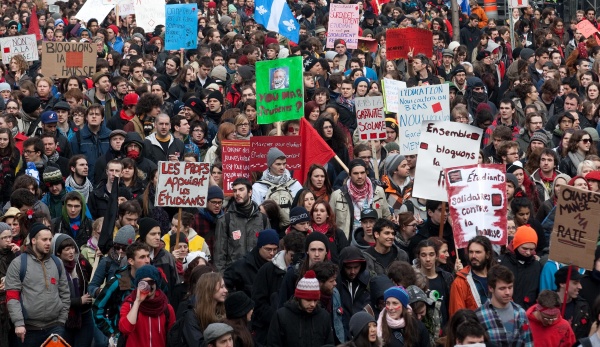
In Quebec students continue to protest the raising of tuition fees, although Quebec has the lowest in Canada. Violence has marked the protests and certainly has not won them the sympathy of citizens.
TransCanada Corp has announced that it has resubmitted its application for approval of the XL Keystone pipeline, which was rejected by the Obama Administration earlier this year. The Administration cited environmental concerns, while proponents called it a political decision during an election year.
In Alberta the Highway 63 issue was front end centre, culminating on Saturday in a rally in Fort McMurray to urge the Alberta government to make the highway, which is touted as the deadliest highway in Alberta, a priority. Premier Alison Redford has responded by stating that she would have the Transportation Minister make it a top priority, once her cabinet is appointed. She did not respond to an invitation to join the rally in Fort McMurray.
Friday afternoon Elections Canada investigators said that they believe that the IP address used to send misleading robocalls to Guelph voters on election day was the same address used by a worker from the campaign office of local Conservative candidate Marty Burke, Elections Canada investigators believe.
The address was apparently used by campaign worker Andrew Prescott to arrange legitimate calls through RackNine, the Edmonton voice broadcasting firm.
But the same IP address was also used to arrange the fraudulent “Pierre Poutine” calls that pretended to be from Elections Canada and sent hundreds of electors to the wrong polling stations, Elections Canada alleges in court documents.
RackNine records provided to Elections Canada showed that Prescott’s account had been accessed from a Rogers IP address in Guelph, 99.225.28.34.
The IP addresses used by Pierre Poutine to set up the calls were hidden by a proxy server that masks the originating IP. On one occasion, however, Poutine — or Pierre Jones, as he was known to RackNine — made contact from same address used to access Prescott’s account with the company. National Post
Needless to say this produced a number of tweets on Friday by those that oppose the Harper government, which includes environmentalists and the far left, calling for Harper's dismissal, including some name calling.
Since the investigation is in the hands of Elections Canada and it appears that the Conservative party is co-operating, we should all take a deep breath and wait for the results of the investigation. The Conservative Party establishment should also do more to inform the public. Too much secrecy just opens the door to ridicule.
There can be no doubt that the implementation of Stephen Harper's agenda, including the opting out of Kyoto, steamlining of environmental reviews, delegating approval authority to provinces, budget cuts, which the unions say reduces services to Canadians, and the fait accompli of health care spending have raised eyebrows with the opposition. None of this should have been a surprise though. The Harper government has been quite clear what legislation it wanted to pass.
The reform of Old Age Security by changing to eligibility from age 65 to 67 was a surprise and one could criticize the first official mention of it. Prime Minister Harper mentioned it for the first time earlier this year at an economic forum in Davos, Switzerland. The reform affects those that are 54 or younger this year. It does not affect current recipients or those close to retirement.
Canada has a couple of plans that permit people to save for their pensions. Those included the Registered Retirement Savings Plan (RRSP), a tax deferment plan and the Tax Free Savings Account (TSFA). 20% of ones earning can be deposited into RRSP, while Canadians can save $5000 annually in their TSFA. Of course, for Canadians just getting by it will be difficult to deposit into either of those accounts.
Next week, the Robocall issue should be front and centre again, making for interesting exchanges in the House of Commons during Question Period. The F35 issue will continue to haunt the government and there is sure to be more pushback by environmentalists. Peter Kent and John Oliver will have to be on their toes.
With the success of the New Democrats, the Liberal Party appears to be looking for a new identitiy, moving it closer to the centre. IMHO what the Liberal party really needs is new ideas, a generational change in leadership and an outline plan of how it would move ahead as a governing party.
While it is the oppositions job to pose, Canadians at some point will also want to see a plan, which is funded, on how they would move the country ahead.
There are certainly turbulent times ahead in Canadian politics.
In Quebec students continue to protest the raising of tuition fees, although Quebec has the lowest in Canada. Violence has marked the protests and certainly has not won them the sympathy of citizens.
TransCanada Corp has announced that it has resubmitted its application for approval of the XL Keystone pipeline, which was rejected by the Obama Administration earlier this year. The Administration cited environmental concerns, while proponents called it a political decision during an election year.
In Alberta the Highway 63 issue was front end centre, culminating on Saturday in a rally in Fort McMurray to urge the Alberta government to make the highway, which is touted as the deadliest highway in Alberta, a priority. Premier Alison Redford has responded by stating that she would have the Transportation Minister make it a top priority, once her cabinet is appointed. She did not respond to an invitation to join the rally in Fort McMurray.
Friday afternoon Elections Canada investigators said that they believe that the IP address used to send misleading robocalls to Guelph voters on election day was the same address used by a worker from the campaign office of local Conservative candidate Marty Burke, Elections Canada investigators believe.
The address was apparently used by campaign worker Andrew Prescott to arrange legitimate calls through RackNine, the Edmonton voice broadcasting firm.
But the same IP address was also used to arrange the fraudulent “Pierre Poutine” calls that pretended to be from Elections Canada and sent hundreds of electors to the wrong polling stations, Elections Canada alleges in court documents.
RackNine records provided to Elections Canada showed that Prescott’s account had been accessed from a Rogers IP address in Guelph, 99.225.28.34.
The IP addresses used by Pierre Poutine to set up the calls were hidden by a proxy server that masks the originating IP. On one occasion, however, Poutine — or Pierre Jones, as he was known to RackNine — made contact from same address used to access Prescott’s account with the company. National Post
Needless to say this produced a number of tweets on Friday by those that oppose the Harper government, which includes environmentalists and the far left, calling for Harper's dismissal, including some name calling.
Since the investigation is in the hands of Elections Canada and it appears that the Conservative party is co-operating, we should all take a deep breath and wait for the results of the investigation. The Conservative Party establishment should also do more to inform the public. Too much secrecy just opens the door to ridicule.
There can be no doubt that the implementation of Stephen Harper's agenda, including the opting out of Kyoto, steamlining of environmental reviews, delegating approval authority to provinces, budget cuts, which the unions say reduces services to Canadians, and the fait accompli of health care spending have raised eyebrows with the opposition. None of this should have been a surprise though. The Harper government has been quite clear what legislation it wanted to pass.
The reform of Old Age Security by changing to eligibility from age 65 to 67 was a surprise and one could criticize the first official mention of it. Prime Minister Harper mentioned it for the first time earlier this year at an economic forum in Davos, Switzerland. The reform affects those that are 54 or younger this year. It does not affect current recipients or those close to retirement.
Canada has a couple of plans that permit people to save for their pensions. Those included the Registered Retirement Savings Plan (RRSP), a tax deferment plan and the Tax Free Savings Account (TSFA). 20% of ones earning can be deposited into RRSP, while Canadians can save $5000 annually in their TSFA. Of course, for Canadians just getting by it will be difficult to deposit into either of those accounts.
Next week, the Robocall issue should be front and centre again, making for interesting exchanges in the House of Commons during Question Period. The F35 issue will continue to haunt the government and there is sure to be more pushback by environmentalists. Peter Kent and John Oliver will have to be on their toes.
With the success of the New Democrats, the Liberal Party appears to be looking for a new identitiy, moving it closer to the centre. IMHO what the Liberal party really needs is new ideas, a generational change in leadership and an outline plan of how it would move ahead as a governing party.
While it is the oppositions job to pose, Canadians at some point will also want to see a plan, which is funded, on how they would move the country ahead.
There are certainly turbulent times ahead in Canadian politics.
Wednesday, 2 May 2012
Did Thomas Mulcair Play the Race Card
"It's a clear case of a double standard. One for an American black man from Chicago, another for a British white man coming out of federal penitentiary," Mulcair said.
Mulcair was referring to the case of Douglas Gary Freeman, who was arrested in Toronto in 1969 for a 1969 police shooting. Although Freeman pleaded self-defence he was convicted of aggravated battery and spend thirty days in jail. He served three years in jail, prior to extradition to the U.S.
On CBC's Power and Politics yesterday, Douglas Freeman made his case. He has raised a family in Canada and is really only looking to be re-united with his family. Having heard his plea, his case should most certainly be reassessed.
Being denied entry into Canada based on a criminal conviction seems harsh, considering that even Omar Khadr will be returned to Canada. Regardless this should not be made an issue of race. Anyone, who has looked south of the border and observed politics there recently can see that the politics of race and division are well and alive.
Conrad Black, who has lost most of his assets and spend 42 months in rison on fraud and obstruction of justice charges related to his work at Hollinger, is due to be released next week. He is a member of the Order of Canada and a member of the British Parliament's House of Lords. In a dispute with former Prime Minister Jean Chretien, he renounce his Canadian citizenship when he was appointed to the House of Lords. His childhood home is in Canada and Black says he has about $80 Million in assets.
When questioned about the Black case during Question Period, Immigration Minister Jason Kenney said that cases like this are a matter of privacy. He also stated that he had indicated to his department that in respect to Black he would have no involvement.
"I can advise the House, with respect to this individual, I indicated to my department that I would not have any involvement in an application from that individual and that his application would be treated by highly trained members of our public service."
He also called Gary Freeman a cop killer, a comment he apologize for later and said he should have called him a cop shooter.
Those statements prompted Mulcair's allegations, which could be considers as invoking the race card. Be it as it may, the comments emphasizing race are over the line. Gary Freeman's case should be re-examined. By all indications Mr. Freeman should be given a permit on compassionate reasons to reunite with his family and grandchildren, but please keep race out of it.
The recent discourse in Canada's Parliament is unbecoming. As an example during another session of Question period last week, a question arose regarding Canada's military involvement past 2014.
When Mulcair asked the prime minister about the extension, Harper attacked the NDP for being pacifists regardless of the situation. "In 1939, the NDP leader didn’t even want to support the fight against Hitler," said Harper. Of course the PM was referring to the CCF, the predecessor of the NDP. This created a lot of chatter in the twitter sphere, with Canadians offering history lessons to the PM. Canadian Politics this Week.
Both sides would be well advised to get back to civil debate.
Friday, 27 April 2012
Canada - Conservatives and New Democrats in Statistical Tie - Nanos Poll
The constant hammering by the opposition parties and controversies seem to have had an effect on how Canadians feel about the Conservative gouvernment. A Nik Nanos poll has the Conservative Party in a statistical tie with the New Democratic Party. While Stephen Harper still holds a lead as the most trusted leader, Opposition Leader Thomas Mulcair has moved up considerably in all leadership categories.
While the Conservative Party support has remained relatively unchanged at 34.7%, the New Democrats have improved significantly at 32.4%, mostly at the cost of the Liberal Party, which has drooped 6 points to 23.3%. Canadians also seem to like what they see in New Democratic Leader Thomas Mulcair. Although he is still 12 percentage points behind Stephen Harper, he has picked up 33.5 points in the leadership index, while Liberal leader Bob Rae has dropped 17.9%. All party leaders took a drop, with Stephen Harper taking the biggest loss at 36.6, definitely a good showing for the NDP leader.
Canadians still consider Stephen Harper as the most competent and trustworthy leader, although Thomas Mulcair has moved up in those categories as well. The election of Thomas Mulcair as leader of the New Democrats has definitely had an impact.
Along with Mulcair's leadership bump and the controversies, the F35 boondoggle, robocalls, internet privacy legislation, excessive travel expenditures by some MPs, budget cuts, it would appear that the Prime Minister will have tough selling job. This poll, however is only a blurb in time and as was shown in the Alberta election polls, they are not always accurate. One can assume though that Mulcair has had an impact on the Canadian political scene.
Poll Details:
Methodology
Between April 13th and 18th, Nanos Research conducted a random telephone survey of 1,200 Canadians 18 years of age and older. A random telephone survey of 1,200 Canadians is accurate plus or minus 2.8 percentage points, 19 times out of 20. For 975 committed voters, it is accurate plus or minus 3.2 percentage points, 19 times out of 20.
Results for February 29th, 2012 are from a random telephone survey of 1,203 Canadians conducted between February 25th and 29th, 2012. A random telephone survey of 1,203 Canadians is accurate plus or minus 2.8 percentage points, 19 times out of 20.
National Ballot Question: For those parties you would consider voting for federally, could you please rank your top two current local preferences? (Committed voters only - First Preference)
Conservative 34.7% (-1.0)
NDP 32.4% (+7.4)
Liberal 23.3% (-6.2)
Green 4.2% (+0.8)
Bloc Quebecois 3.9% (-1.0)
*Undecided 18.8% (+2.4)
Leadership Index Questions: As you may know, [Rotate] Bob Rae is the interim leader of the federal Liberal Party, Stephen Harper is the leader of the Conservative Party of Canada, Thomas Mulcair is the leader of the federal NDP, Elizabeth May is the leader of the federal Green Party and Daniel Paillé is the leader of the Bloc Quebecois. Which of the federal leaders would you best describe as: the most trustworthy, the most competent, the leader with the best vision for Canada. (n=1,200)
Leadership Index Score
Stephen Harper 65.8 (-36.6)
Thomas Mulcair 53.8 (+33.5)
Bob Rae 36.5 (-17.9)
Elizabeth May 19.6 (-5.0)
Daniel Paillé 5.3 (-6.4)
The Most Trustworthy Leader (n=1,200)
Stephen Harper 20.0% (-11.7)
Thomas Mulcair 19.5% (+12.7)
Bob Rae 13.6% (-5.9)
Elizabeth May 8.4% (-2.9)
Daniel Paillé 2.0% (-2.3)
Unsure 20.6% (+6.8)
None 15.8% (+3.3)
The Most Competent Leader (n=1,200)
Stephen Harper 24.2% (-13.9)
Thomas Mulcair 17.0% (+11.3)
Bob Rae 12.2% (-6.5)
Elizabeth May 5.1% (-0.1)
Daniel Paillé 1.3% (-2.7)
Unsure 24.4% (+5.5)
None 15.8% (+6.5)
The Leader with the Best Vision for Canada’s Future (n=1,200)
Stephen Harper 21.6% (-11.0)
Thomas Mulcair 17.3% (+9.5)
Bob Rae 10.7% (-5.5)
Elizabeth May 6.1% (-2.0)
Daniel Paillé 2.0% (-1.4)
Unsure 27.1% (+5.7)
None 15.2% (+4.7)
Top Issue Question: What is your most important NATIONAL issue of concern? [Unprompted] (n=1,200)
*The numbers in parentheses denote the change from February 29th, 2012 (n=1,203).
Jobs/economy 21.9% (-3.9)
Healthcare 21.6% (+5.7)
Education 10.1% (+4.7)
The environment 9.3% (+2.9)
High taxes 5.1% (+2.1)
Unsure 16.6% (-1.4)
Monday, 16 April 2012
Canadian Politics - Two Opposing Visions
The New Democratic Party has been surging in the polls. In the most recent polls, the surge is most prominent in the province of Quebec, lags in Ontario, but has brought the party into a statistical tie with the Conservative in the rest of the country. Both the Liberal Party of Canada and the Conservative Party have lost favour in Quebec. The New Democrats (NDP) have a newly elected leader, Thomas Mulcair, who is also the Leader of the Official Opposition.
The Conservative Party and the NDP represent two totally different visions for Canada.
The Conservative Party, similar to the GOP stands for lower taxes, smaller government, more decentralization of federal government powers to the provinces, and a tougher stand on "law and order" issues. During the last election, the Conservative Party ran on the Canada
Action Plan, with a budget already introduced during the previous
session. It has promised Senate reform, including term limits. One of
the mainstays of the Reform Party was a EEE (Elected, Equal and
Effective) Senate. Harper may be able to achieve the Elected and
Effective, however equal requires the approval of the provinces and
Quebec and Ontario are not likely to give up their present number
advantage.
The New Democratic Party stands for many issues embraced today in the Democratic Party. The party embodies gender equality and equal rights for the LBGT community, improving environmental protection, national water standards, reducing poverty and increasing corporate taxes, while decreasing taxes for small business. It further promotes aggressive human rights protection, improving public transportation, improving universality of health care, to include prescription drug coverage and dental care. During the last election, the party unveiled its 2011 Platform.
More on Canadian Political Parties Here
The Conservative Party has been plagued with several problems recently, including "Robocalls", buget cuts, particulary in the public service sector and most recently the procurement of the F35B stealth fighter. A recent report by the Auditor General suggests that the government misled the Canadian public on the actual cost of the program. The government contends that it is an accounting issue. Without going into specific details, the robocalls, budget and the fighter issue have raised enough doubt to make the government vulnerable. The conservative government is also criticized for its position on environmental issues, particularly the Alberta Oil Sands and the construction of the Northern Gateway pipeline, which would transport oil from Alberta to the west coast, through environmentally sensitive areas. The majority of citizens in British Columbia oppose the pipeline and oil tanker traffic on the west coast.
Thomas Mulcair, the newly elected leader of the NDP, says that he has an obligation to reach out beyond the traditional base of the NDP and try to rally all progressives across Canada.
"My primary obligation is to reach out beyond the NDP's traditional base, to try to rally all progressives across Canada under the NDP banner."
This appears to have occurred in Quebec with relative success. Mulcair has his work cut out in Ontario and Western Canada. Some of his recent popularity may be due to a bump in poll numbers after the leadership race and the problems that the present government is experiencing. Three years in politics is a long time though. In the end it will boil down to the health of the economy and delivery of health care.
The battle lines have been drawn and there are two opposing views, with very different platforms. Both parties will have to sell their platform as the best direction for the country.
The Conservative Party and the NDP represent two totally different visions for Canada.
The Conservative Party, similar to the GOP stands for lower taxes, smaller government, more decentralization of federal government powers to the provinces, and a tougher stand on "law and order" issues. During the last election, the Conservative Party ran on the Canada
Action Plan, with a budget already introduced during the previous
session. It has promised Senate reform, including term limits. One of
the mainstays of the Reform Party was a EEE (Elected, Equal and
Effective) Senate. Harper may be able to achieve the Elected and
Effective, however equal requires the approval of the provinces and
Quebec and Ontario are not likely to give up their present number
advantage.The New Democratic Party stands for many issues embraced today in the Democratic Party. The party embodies gender equality and equal rights for the LBGT community, improving environmental protection, national water standards, reducing poverty and increasing corporate taxes, while decreasing taxes for small business. It further promotes aggressive human rights protection, improving public transportation, improving universality of health care, to include prescription drug coverage and dental care. During the last election, the party unveiled its 2011 Platform.
More on Canadian Political Parties Here
The Conservative Party has been plagued with several problems recently, including "Robocalls", buget cuts, particulary in the public service sector and most recently the procurement of the F35B stealth fighter. A recent report by the Auditor General suggests that the government misled the Canadian public on the actual cost of the program. The government contends that it is an accounting issue. Without going into specific details, the robocalls, budget and the fighter issue have raised enough doubt to make the government vulnerable. The conservative government is also criticized for its position on environmental issues, particularly the Alberta Oil Sands and the construction of the Northern Gateway pipeline, which would transport oil from Alberta to the west coast, through environmentally sensitive areas. The majority of citizens in British Columbia oppose the pipeline and oil tanker traffic on the west coast.
Thomas Mulcair, the newly elected leader of the NDP, says that he has an obligation to reach out beyond the traditional base of the NDP and try to rally all progressives across Canada.
"My primary obligation is to reach out beyond the NDP's traditional base, to try to rally all progressives across Canada under the NDP banner."
This appears to have occurred in Quebec with relative success. Mulcair has his work cut out in Ontario and Western Canada. Some of his recent popularity may be due to a bump in poll numbers after the leadership race and the problems that the present government is experiencing. Three years in politics is a long time though. In the end it will boil down to the health of the economy and delivery of health care.
The battle lines have been drawn and there are two opposing views, with very different platforms. Both parties will have to sell their platform as the best direction for the country.
Monday, 9 April 2012
Alberta Election - Wildrose Announces Accountabilty Act and MLA Pay
The Alberta election campaign moves into its third week, with leaders unveiling more of their platforms. Danielle Smith unveiled the Accountability Act and addressed salaries for Members of the Legislative Assembly (MLAs). She opined that a $125,000 salary for MLAs, without extra bonuses for serving on committees was ample, since serving in the legislature is a public service.
The Wildrose Accountability Act addresses several issues, including Freedom of Information and Protection of Privacy (FOIP) laws, introducing new referendum rules, and the high-profile issue of MLA pay.
"I understand there is some debate about whether you pay more to get higher quality applicants, or whether you acknowledge that it is a public service, and it is a sacrifice, and you get people in there for the right reason."
MLAs recently passed a 33% pay raise, which was met by outcries from the public. Smith's announcement addresses this issue.
Raj Sherman, Liberal Leader is in agreement with Danielle Smith on the MLA pay issue, with his own plan to roll back MLA pay and put a cap on committee pay.
"I've found public service to be a labour of love, it shouldn't be the best paid job you've ever had."
He also pledged that a Liberal government would change the relationship with communities, since communities should not be treated as wards of the province. He would establish "Big City Charters for Edmonton and Calgary" and save $1.5 billion of surplus resource revenue into a municipality heritage fund every year.
Maybe that plan would get some of our country roads into a safe condition. Of course this is all dependent on resource revenue remaining relatively high. With health care being the top priority in Alberta and 40% of the budget already allocated to it, major changes will be needed to reduce emergency room waiting list and suitable elderly care. Maybe giving a percentage would have been wiser than putting a dollar amount to it. A dollar amount includes too many assumptions.
Alison Redford was touring rural Alberta today and promised to spend more money on agricultural research, offer bursaries for rural students and refund tuition to doctors who agree to practice in rural communities.
"Our agricultural industry as it is, is more important than ever," she said. "But what comes next is just as exciting and we need policies that will continue to make communities vibrant and prosperous."
“My government will ensure that good jobs, health and education services that support a desirable and successful lifestyle are available in rural areas."
Redford said that her package would come to $47 Million in 2013-14, with some covered in current ministry budgets. The plan is intended to boost agricultural society funding by $2-million per year and spend $3-million on high-speed Internet infrastructure.
This is another commitment that would obviously require further clarification. While the doctor tuition refund is desireable, with Alberta hiring so many foreign doctors to fill the void, again no dollar value or goal for the number of doctors was given.
Since high speed internet is still wanting in Alberta, this also requires clarification on how $3 Million will expand it. Satellite internet is too restrictive, both in download quotas, with its fair use policy (250 MB for Xplornet) and its speed. Cable is obviously out of the question, due to cost. This leaves wireless internet and more towers or repeaters.
As the party leaders lead up to the debate on April 12th, there are a number of questions that need to be answered. Redford passed a budget just prior to calling the election, it would be prudent for all leaders to be prepared to show a dollar amount for their promises and how they hope to pay for it.
Alison Redford's budget has been passed by the majority progressive conservative government, how much more will her additional promises cost?
Brian Mason's New Democrats will be making a health care announcement later today.
Stay Tuned.
The Wildrose Accountability Act addresses several issues, including Freedom of Information and Protection of Privacy (FOIP) laws, introducing new referendum rules, and the high-profile issue of MLA pay.
"I understand there is some debate about whether you pay more to get higher quality applicants, or whether you acknowledge that it is a public service, and it is a sacrifice, and you get people in there for the right reason."
MLAs recently passed a 33% pay raise, which was met by outcries from the public. Smith's announcement addresses this issue.
Raj Sherman, Liberal Leader is in agreement with Danielle Smith on the MLA pay issue, with his own plan to roll back MLA pay and put a cap on committee pay."I've found public service to be a labour of love, it shouldn't be the best paid job you've ever had."
He also pledged that a Liberal government would change the relationship with communities, since communities should not be treated as wards of the province. He would establish "Big City Charters for Edmonton and Calgary" and save $1.5 billion of surplus resource revenue into a municipality heritage fund every year.
Maybe that plan would get some of our country roads into a safe condition. Of course this is all dependent on resource revenue remaining relatively high. With health care being the top priority in Alberta and 40% of the budget already allocated to it, major changes will be needed to reduce emergency room waiting list and suitable elderly care. Maybe giving a percentage would have been wiser than putting a dollar amount to it. A dollar amount includes too many assumptions.
Alison Redford was touring rural Alberta today and promised to spend more money on agricultural research, offer bursaries for rural students and refund tuition to doctors who agree to practice in rural communities.
"Our agricultural industry as it is, is more important than ever," she said. "But what comes next is just as exciting and we need policies that will continue to make communities vibrant and prosperous."
“My government will ensure that good jobs, health and education services that support a desirable and successful lifestyle are available in rural areas."
Redford said that her package would come to $47 Million in 2013-14, with some covered in current ministry budgets. The plan is intended to boost agricultural society funding by $2-million per year and spend $3-million on high-speed Internet infrastructure.
This is another commitment that would obviously require further clarification. While the doctor tuition refund is desireable, with Alberta hiring so many foreign doctors to fill the void, again no dollar value or goal for the number of doctors was given.
Since high speed internet is still wanting in Alberta, this also requires clarification on how $3 Million will expand it. Satellite internet is too restrictive, both in download quotas, with its fair use policy (250 MB for Xplornet) and its speed. Cable is obviously out of the question, due to cost. This leaves wireless internet and more towers or repeaters.
As the party leaders lead up to the debate on April 12th, there are a number of questions that need to be answered. Redford passed a budget just prior to calling the election, it would be prudent for all leaders to be prepared to show a dollar amount for their promises and how they hope to pay for it.
Alison Redford's budget has been passed by the majority progressive conservative government, how much more will her additional promises cost?
Brian Mason's New Democrats will be making a health care announcement later today.
Stay Tuned.
Wednesday, 14 December 2011
Emotions Fly in House of Commons - Liberal MP Calls Minister a Piece of S--t
Canada has exercised its legal right to withdraw from the Kyoto Accord. Environment Minister Peter Kent announced that he had informed the UN of Canada's intentions. Since the announcement emotions and attacks on the Conservative Government have been more emotional than ever. Today's outburst by Liberal MP, Justin Trudeau, took the cake though. He called the Energy Minister a "piece of shit."
Green Party MP Elizabeth May and NDP Energy Critic Megan Leslie have lead the charge against the government. There were allegations of Canada being an impediment to moving forward on a climate treaty.
During the House of Commons Question Period today, a period which is basically a circus for the media, after comments from Megan Leslie, NDP, Peter Kent told the Nova Scotia MP that she was ill informed, since she had not attended the conference.
Apparently at that moment Liberal MP Justin Trudeau lost his cool and called the Minister a "piece of shit". Unlike his father, who seemingly uttered a profanity in the House of Commons and said that it was fuddle duddle, Trudeau's swearing was heard loud and clear.
During the daily Question Period, the House of Commons becomes a circus and Canadians know it. This has gone beyond the bounds of decency though, even though Trudeau apologized.
"I lost my temper and used language that was most decidedly unparliamentary and for that I unreservedly apologize and withdraw my remarks," he said.
Kent said he wasn't troubled by the language but asked Trudeau to apologize to the House of Commons.
Elizabeth May was quick to put it out on twitter "Justin Trudeau explained why he lost his temper. (Kent accusing Megan Leslie of skipping COP17). And he "unreservedly" apologized."
Whether or not Kent said Leslie skipped the conference is questionable. News reports just quoted him as saying that she ill informed because she wasn't there.
It's getting to the point, where the behaviour in the House of Commons is getting out of hand. While opposition opinions should be desireable, this nastiness has no place in our Parliament. Let's quit behaving like little children and grow up.
Green Party MP Elizabeth May and NDP Energy Critic Megan Leslie have lead the charge against the government. There were allegations of Canada being an impediment to moving forward on a climate treaty.
During the House of Commons Question Period today, a period which is basically a circus for the media, after comments from Megan Leslie, NDP, Peter Kent told the Nova Scotia MP that she was ill informed, since she had not attended the conference.
Apparently at that moment Liberal MP Justin Trudeau lost his cool and called the Minister a "piece of shit". Unlike his father, who seemingly uttered a profanity in the House of Commons and said that it was fuddle duddle, Trudeau's swearing was heard loud and clear.
During the daily Question Period, the House of Commons becomes a circus and Canadians know it. This has gone beyond the bounds of decency though, even though Trudeau apologized.
"I lost my temper and used language that was most decidedly unparliamentary and for that I unreservedly apologize and withdraw my remarks," he said.
Kent said he wasn't troubled by the language but asked Trudeau to apologize to the House of Commons.
Elizabeth May was quick to put it out on twitter "Justin Trudeau explained why he lost his temper. (Kent accusing Megan Leslie of skipping COP17). And he "unreservedly" apologized."
Whether or not Kent said Leslie skipped the conference is questionable. News reports just quoted him as saying that she ill informed because she wasn't there.
It's getting to the point, where the behaviour in the House of Commons is getting out of hand. While opposition opinions should be desireable, this nastiness has no place in our Parliament. Let's quit behaving like little children and grow up.
Sunday, 4 December 2011
Canada's New Democrats Leadership Hopefuls First Debate
The New Democratic Party had an unprecedented success during Canada's federal election in May of this year. The party overtook the Liberal Party as the official opposition. While most of the gains were in Quebec, it has realigned the party to attempt a run at government in the next election. Shortly after the election, the NDP's popular leader Jack Layton died and this has set off a frenzy of those vying for the leadership of the party. The first of six leadership debates will take place today broadcast on the CTV Newschannel at 2:00 pm EST. The new leader will be chosen on March 24th.
The debate for the nine candidates will be conducted over two hours, with the first hour in English and the second hour in French. All nine candidates are bilingual.
Ottawa MP Paul Dewar, Toronto MP Peggy Nash, Manitoba MP Niki Ashton, Former Party President Brian Topp, Montreal MP Thomas Mulcair and Nova Scotia MP Robert Chisholm will be on stage along with MP Romeo Saganash, B.C. MP Nathan Cullen and Nova Scotia businessman Martin Singh.
The New Democratic Party
The New Democratic Party evolved from the Co-operative Commonwealth Federation, which was a movement that emerged from Saskatchewan. The newly formed Canadian Labour Congress started negotiating with the CCF in 1956 to bring about a merger of the organized labour and the political left. In 1961 the New Democratic Party emerged, led by former Saskatchewan Premier Tommy Douglas. The present interim leader of the Party is Nycole Turmel. The party's popular leader Jack Layton passed away on August 22, 2011. The Party holds 103 of 308 seats in Parliament and is the official opposition. Canadian Political Parties
The subject of today's debate will be the economy. With Europe's debt crisis and the potential collapse of the global economy, it will be interesting how far left the NDP's approach to solving the economic woes will be. Not unlike the left wing of the Democratic Party, the NDP believes that the government is the solution to most problems. Europeans and Americans have pretty well determined that the problem has been excessive spending. So this debate should prove to be interesting. Hopefully the media does not give the potential leaders a free ride.
With little time to answer questions, about one minute per candidate, the outcome could be similar to the GOP Presidential debate and the frontrunners could change frequently between now and May. If the debate accomplishes one thing, it must attempt to appeal to Canadian West of the Quebec border. Expect most of the candidates attacking the policies of the governing Conservatives and not so much each other. Ideologically the candidates are on the same sheet. Their vision for Canada and its implementation may vary slightly.
The debate for the nine candidates will be conducted over two hours, with the first hour in English and the second hour in French. All nine candidates are bilingual.
Ottawa MP Paul Dewar, Toronto MP Peggy Nash, Manitoba MP Niki Ashton, Former Party President Brian Topp, Montreal MP Thomas Mulcair and Nova Scotia MP Robert Chisholm will be on stage along with MP Romeo Saganash, B.C. MP Nathan Cullen and Nova Scotia businessman Martin Singh.
The New Democratic Party
The New Democratic Party evolved from the Co-operative Commonwealth Federation, which was a movement that emerged from Saskatchewan. The newly formed Canadian Labour Congress started negotiating with the CCF in 1956 to bring about a merger of the organized labour and the political left. In 1961 the New Democratic Party emerged, led by former Saskatchewan Premier Tommy Douglas. The present interim leader of the Party is Nycole Turmel. The party's popular leader Jack Layton passed away on August 22, 2011. The Party holds 103 of 308 seats in Parliament and is the official opposition. Canadian Political Parties
The subject of today's debate will be the economy. With Europe's debt crisis and the potential collapse of the global economy, it will be interesting how far left the NDP's approach to solving the economic woes will be. Not unlike the left wing of the Democratic Party, the NDP believes that the government is the solution to most problems. Europeans and Americans have pretty well determined that the problem has been excessive spending. So this debate should prove to be interesting. Hopefully the media does not give the potential leaders a free ride.
With little time to answer questions, about one minute per candidate, the outcome could be similar to the GOP Presidential debate and the frontrunners could change frequently between now and May. If the debate accomplishes one thing, it must attempt to appeal to Canadian West of the Quebec border. Expect most of the candidates attacking the policies of the governing Conservatives and not so much each other. Ideologically the candidates are on the same sheet. Their vision for Canada and its implementation may vary slightly.
Subscribe to:
Posts (Atom)